How to Discipline a Toddler Who Doesn’t Listen
Frustrated when your child disobeys on purpose or pushes your buttons? Learn how to discipline a toddler who doesn’t listen or ignores you.

“It’s cleanup time! Can you put the cars back in the box?” I asked my toddler. But nope, he stayed rooted in place, playing with the cars. Not only that, a smile spread across his face, as if the whole thing was a big joke.
Dealing with a toddler not doing what you asked him to do can be challenging, even for the most patient parent.
The defiance triggers a raw anger you never knew you had, making you wonder what it’ll finally take to get him to listen. Nagging, timeouts, and trying to reason with him don’t work.
Later, you feel terrible when you realize how petty the initial “argument” had been: talking when he should’ve been napping, not coming to the bathroom as you asked him to, and yes, refusing to clean up his cars.
You know something has to change, especially when you’re losing your temper with your toddler more often than you’d like.
Thankfully, you can turn things around, especially when you take a different approach than what most parenting advice tells you to do. Below are several techniques to reduce these power struggles and get him to listen. As one parent said:
“Very helpful! We are struggling with defiance right now and it just drains me. Thank you for the tips!” -Marina Helsel
Table of Contents
Redefine “discipline”
Most of us think of discipline as what we do after our kids misbehave—the consequences that happen when they don’t do as they’re told.
But I’ve learned that discipline is something different. Discipline is teaching. We’re teaching children how to behave and helping them understand and express their emotions.
As I say in my book, Parenting with Purpose:
“Discipline is nothing more than this: teaching and helping your child to behave. It’s a new way of thinking about discipline, isn’t it? Discipline isn’t just punishment, consequences, or what to do when kids misbehave. Discipline is teaching our kids how to act.”
This is why time outs don’t work or why you get suckered into power struggles with your toddler. But when you see discipline as teaching, you’re forced to ask yourself what she needs to learn instead.
What teachable moment can she gain from this? What new habits, values, and consequences can she learn from this challenging behavior?

Free resource: Are your current discipline methods just not cutting it? Learn 9 parenting strategies that can help you deal with these challenging behaviors. Imagine transforming your relationship using just the tips you’ll learn right here. Join my newsletter and grab your PDF freebie below—at no cost to you. You’ll also get my newsletters, which parents say they LOVE:
“Always love your posts and videos. Your freebies are fabulous! I recommend you to all my friends.” -Linda Barber Pike

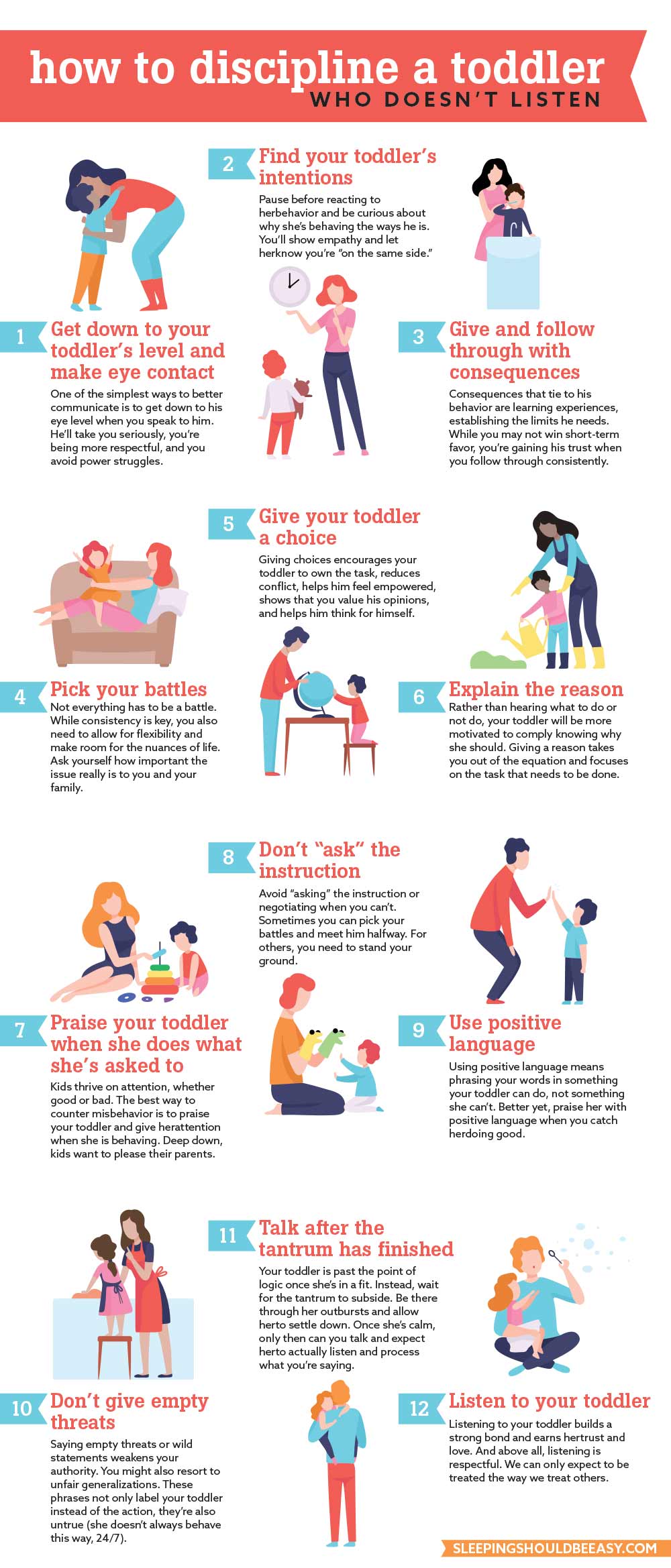
Find your toddler’s intentions
Defiance seems to be everywhere. You see it when your child refuses to eat or when she should know better not to jump on the bed (especially after you’ve asked her to stop many times before).
But if I had to guess, she’s not misbehaving to make you angry. Go further and you might see that she was trying to fix a toy right when you asked her to come to the table to eat. Jumping wasn’t rebellion, but excitement over her new bed.
Pause before reacting and be curious about why she’s behaving the way she is so she feels like you’re on the same side. Before laying out consequences, acknowledge and show empathy with how she feels and why she’s not listening.
Maybe she felt tired from a long day, needs your company, or wants the same toy her brother is playing with. Dive into her mindset and look for the reason behind her actions—she’ll comply when she feels understood, not attacked or scolded.
And avoid unfair generalizations. For instance, don’t say, “You never listen to what I say,” or “You always misbehave.” These phrases not only label her instead of the action, they’re also untrue (she doesn’t always behave this way, 24/7).
Create an environment suitable for your toddler
I realized I had grown tired of constantly telling my toddler to stop touching the remote control.
Why can’t he learn?! I thought.
That is, until I realized that a better option might be to put the remote control out of his reach to begin with.
Your toddler has done a good job in learning what is and isn’t okay to do, and often through constant reminders. But sometimes, it’s easier not to “tempt” him at all and make sure his surroundings help him listen.
For instance, have easy-to-access storage boxes so he can quickly clean his toys. Put markers away if you’re tired of telling him not to draw on himself. Baby proof certain parts of your home so he can explore with more autonomy.
Helping him thrive includes setting up the right environment that can help him do just that.
Give and follow through with consequences
Have you ever told your toddler he’d better behave… or else? Not only are empty threats ineffective, but they’re also rarely implemented.
Saying empty threats or wild statements weakens your authority. “If you don’t pick up your toys, I’m going to throw them all out!” bears little weight when you don’t follow through with it.
Following through with consequences—especially those that tie to his behavior—allows him to learn from the experience and establishes the limits he needs.
And keeping your word reinforces the trust he places in you. While you may not win short-term favor, you’re gaining his trust when you follow through consistently. Otherwise, he learns that he can continue to misbehave because the consequences you claim will happen never actually do.
Give your toddler a choice
Giving choices can curb a potential meltdown and encourage your toddler to listen. Offering choices:
- Encourages her to own the task. Putting on a jacket won’t seem like Mom’s Terrible Idea. Instead, she gets to decide between a green or gray jacket.
- Reduces conflict. Avoid many tantrums by drawing attention to the choices she can make, not the task she’s resisting.
- Feels empowering. Making choices allows her to voice her opinions and follow through with them.
- Shows you value her opinions. You make most decisions for her, but you also care and respect the ones she makes.
Fair warning: Offering choices can backfire when not done correctly. She might demand choices when she has none (especially when you offer them too often) or pick an option you don’t like.
The trick is two-part. First, limit how often you give choices (some choices aren’t hers to make). And second, offer a choice between two parent-approved options, either of which you’re okay with.
Let’s say you’re going to grandma’s house, which is the non-negotiable. You might say, “We’re going to grandma’s. Which jacket do you want to wear—the green one or the gray one?” Don’t say, “Do you want to go to grandma’s or stay here at home?” especially if you don’t plan to have her stay.
Explain the reason
Research found that people are more likely to comply when they hear a reason.
The same is true with your toddler. In a world dominated by adults, she can feel resentful of being told what to do all the time. Imagine following rules you don’t always understand or doing things you don’t feel like doing.
Rather than hearing what to do or not do, she’ll be more motivated to comply knowing why she should.
The next time you ask her to do something, follow with a reason: “Don’t jump on the bed—you might fall and hurt yourself.”
Giving a reason takes you out of the equation and focuses on the task that needs to be done. You’re not the “mean mom” who bosses her around just because you can. You’re letting her know why she needs to do what you asked her to.
With a reason, you won’t sound bossy, especially when your words carry a respectful tone as you explain the reason behind your request.
Focus on what your toddler should or could do
A day in the life of a toddler isn’t always easy, especially when you think about how many times they hear the word “no.” We tell them not to run, to stop fidgeting around, or that they can’t climb the bookshelves.
All well-meaning advice, but after a while, hearing limit after limit can feel draining.
Instead, use the power of positive language and talk about what your toddler can or should do, instead of what she can’t or shouldn’t. Tell her to walk along the hallway, sit facing the dining table, or get down from the bookshelves. Same intentions, but said in a way that makes her more likely to comply.
Using positive language means phrasing your words in something she can do, not something she can’t. It’s the difference between “Walk” and “Don’t run.”
Better yet, praise her with positive language when you catch her doing good. Let’s say she isn’t running away in public. Praise her and say, “Look at you walking!”
She’ll respond better to positive language because no one likes being told what not to do. Plus, she’ll also believe that she can behave well. When you say things like, “Don’t you even think about…” you’re not showing faith that she could handle these instructions.
Praise your toddler for listening
Kids thrive on attention, whether good or bad. Unfortunately, arguments, yelling, and scolding are attention they’d rather have than none at all.
The best way to counter misbehavior is to praise your toddler and give her attention when she is behaving.
Maybe you saw her treating her little brother kindly. Point that out and say, “You’re so kind—you made your brother happy when you shared the blocks with him.” Or give her a high-five after she puts her dishes in the sink, all without you asking.
Deep down, kids want to please their parents. They want our approval and are crushed when we’re disappointed or angry with them. Use that to your advantage and praise her when she behaves well.
Don’t “ask” the instruction
Have you pleaded with your toddler to follow an instruction? If I had to guess, he shrugged it off and tuned you out.
Avoid “asking” the instruction or negotiating when you can’t. When you say it’s time to take a bath, make sure you’re not ignored or met with silence. Don’t let him continue to play with his toys or remain rooted where he is.
Instead of “asking” him to do something (“Can you take a bath?”), you should stand your ground and state the task in unavoidable terms (“It’s time to take a bath”).
The bottom line
Disciplining isn’t about being strict or doling out punishments. Instead, it’s teaching your toddler to behave, manage his emotions, and cope with difficult situations.
And yes, you’ll have off days, like everything with parenting. He might behave one moment, only to deliberately disobey once again. There’s no magic bullet—we’re all human and prone to bad days, including kids.
Discipline is helping him learn from the experience—even as he sits and smiles, refusing to place the toy cars back in the box.
Get more tips:
- A Better but Not Always Easier Alternative to Timeouts
- Toddler More Attached to Grandmother? Here’s How to Cope
- Your Guide to Handling Tantrums
- Toddler Acting Out at Daycare? What You Need to Do
- What to Do When Your Toddler Is Hysterical at Bedtime
Don’t forget: Join my newsletter and grab your PDF freebie below—at no cost to you:
