







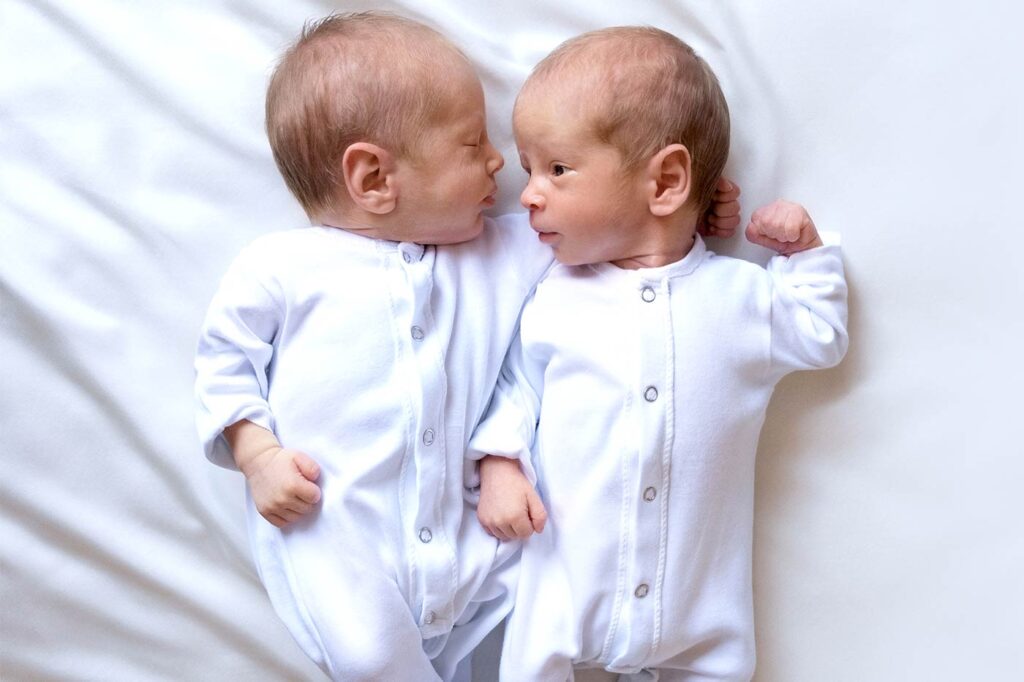

Every so often I get asked if my 2.5 year old son is bilingual. Many of my friends at school ask me how I can teach a toddler two languages and how he can possibly even understand them. You see—I am bilingual. I speak English and Spanish fluently although I grew up speaking only Spanish at home. At school it was a different story. I attended a dual-immersion elementary school where we were taught in both English and Spanish. Growing up bilingual has helped me to become fluent in two languages and to appreciate and admire two different cultures.
My son is fluent in both languages. We speak English solely at home while our family members speak to him in Spanish. Yes, we often throw some Spanish words here and there, but our focus is reading, speaking, and writing in English.
When it comes to bilingualism in young children, numerous studies relate being bilingual with long-term benefits, such as:
Easily learning new words- Putting words into categories
- Good listening skills
- Improved creative thinking
- Better problem-solving skills
- Better multitasking
- Better ability at solving mental puzzles
- Alzheimer’s disease symptoms are delayed
Learning another language at a young age and putting it into practice during a lifetime often result in better cognitive abilities.
Below are a few tips for introducing a second language to your child:
- Read, read, read: I have found it extremely helpful to read to our son in both English and Spanish. The library has a vast variety of multi-language books, videos, dvds, and audios to enjoy as a family. Some of our favorite bilingual books include: My Family and I (Mi Familia y Yo), Ana Cultiva Manzanas (Apple Farmer Annie), and SkippyJon Jones. Other books are also translated in other languages in addition to Spanish, and many books include both English translations as well.
- Talk: As simple as saying “¡Hola!,” speaking to a young child in a different language will enhance communication skills and will help them retain the words being used. And in order to take advantage of all benefits from being bilingual, both languages must be used constantly.
- Online resources: One of my favorite online resources for everything bilingual is Spanglish Baby. This website is packed with relevant information, daily reads, a blog, and the new Spanglish Baby Playground for interactive networking for parents raising bilingual children.
In reality, it is possible for a young child to absorb two or more different languages at the same time. As a parent, my goal for my son is to instill both languages as he grows older.
Are you raising a bilingual child? Why or why not? Do you think being bilingual benefits children? Are you opposed to raising a bilingual child?
Nina’s note: It’s easy for me to relate to this topic since my son is also bilingual. Question to those of you who don’t speak a second language: do you still try to expose your kids to different languages even if English is the only spoken language at home? How important is speaking a second language in your family?
Ana is a stay-at-home mom of a toddler boy. She’s also working on her Bachelor’s degree in Early Childhood Education. Her blog, Mommyhood: From the Heart discusses parenting, motherhood and education.

We are not bilingual. I took four years of Spanish in high school and know quite a bit but am certainly not fluent. I throw Spanish phrases in here and there because I figure it helps my daughter if she’s exposed to another language at any level. I think it’s awesome when kids grow up bilingual; I think it’s giving them a gift.
Steph recently posted..An Open Letter to Introverts in the Church
Hi Steph! Thank you for your comment. That’s really neat you speak Spanish phrases with your daughter even though you’re not fluent. It’s really about being exposed to it rather than being fluent. I do agree that it’s a gift. =)
-Ana xo
Ana recently posted..Happy 142nd Birthday, Dr. Maria Montessori!
[...] the rest of my post here: The benefits of bilingualism in children. Like what you read? Share it with others:FacebookTwitterPinterestStumbleUponLike this:LikeBe the [...]
I’m so hoping my son will be bilingual. My family and I lived in Venezuela for many years so my sister and I speak quite a bit of Spanish (not quite Bilingual). My stepmother though is Venezuelan and continues to speak to him in Spanish. I think in this day and age it is extremely beneficial. I’m also considering when he is older enrolling him in some classes.
Tori Johnson recently posted..DIY sugar lip scrub.
Hi Tori! Thanks for your comment. I love how your stepmother speaks Spanish to your son. Where in Venezuela did you live? I grew up in Miami and I met tons of awesome Venezuelan folks down there. =)
-Ana xo
Ana recently posted..Happy 142nd Birthday, Dr. Maria Montessori!
Both my husband and I are bilingual and we are trying to raise our daughter that way. I speak English to her during the day. When my husband is home and on weekends, we both speak to her in our native language. We find that’s the only way to adequately expose her to both languages as our families don’t live close by and she does not go to daycare. I sometimes wonder if it maybe confusing to her that I use both languages. But maybe this way she’ll see that it can be normal to speak two languages.
Hnmom recently posted..Our First Overnight Trip As A Family
Hi! Thanks for commenting. It’s is absolutely fine speaking to your daughter in both languages. It won’t be confusing for her. Keep up the great work!
-Ana xo
Ana recently posted..Happy 142nd Birthday, Dr. Maria Montessori!
I am bilingual. My grandsons on the east coast are too. When they call, I let them believe that they’re teaching their old gram more Spanish words. They think I’m a very fast learner
)
Teresa Cleveland Wendel recently posted..Rehab for a Betrayal
Hi Teresa! Love how you’re grandsons are teaching you Spanish! Thanks for your comment!
-Ana xo
Ana recently posted..Happy 142nd Birthday, Dr. Maria Montessori!
Hi Ana,
Yes! We were just talking about this over dinner with friends today. We are raising our children bilingual and we had the discussion about what language is the best language to teach your child besides English (Spanish, Mandarin, French??) I said it didn’t matter. I understand that my business-minded hubby and friends were trying to make a point about what will be most beneficial in the future but I said that for a growing little brain-ANY second language is key. Great post!
Betty recently posted..Last Week of Summer Fun
Hi Betty! Yes, I totally agree. No matter what language, a second language will always be beneficial. Thank you so much for stopping by.
-Ana xo
Ana recently posted..Happy 142nd Birthday, Dr. Maria Montessori!
Like I mentioned, my toddler is bilingual; he speaks Tagalog through his caregiver and English from us and knows a few words in Spanish. I don’t speak Tagalog fluently though (or at least not like I used to; I probably sound like a tourist). I probably wouldn’t try too hard to speak to him in another language if that language didn’t come to me as naturally as English.
Nina recently posted..The benefits of bilingualism in children
We use OPOL (one parent one language) with our 18-month-old, with dad speaking Italian and me English. We also have friends who only speak in French to our toddler. Being a language teacher, it’s the most incredible experience to see the bilingual language development in my own child, seeing his comprehension of different languages at a young age and now his vocabulary growing in Italian and English. At his most recent check-up, we were told that at 18 months here in the UK, a boy is only expected to use 4 words; on our way home we stopped counting when we reached 17! In our case, at least, the most recent research into language acquisition that states bilingual children don’t start speaking later than monolingual children, is true.
Anne,
I also read that it’s important for one parent to speak one language, at least in the earlier parts when they’re starting to speak. So even though I can speak a little bit of Tagalog, I didn’t and instead spoke exclusively in English. The reason I read behind it is that it can confuse kids when they hear the same person speaking multiple languages (but that they’re okay hearing different languages from different people, so long as that person is consistent with the language they speak in).
And yup, my son was also delayed in speaking, but according to his pediatrician, bilingualism only delays it by a month at most. Either way, I continue to be impressed with my kid’s vocabulary, grammar and pronunciation too, whether it’s due to bilingualism or not. I’m so happy to hear that your little one is also exceeding the word milestones! I know how terrible I felt when we weren’t meeting them, to all of a sudden surpassing them like crazy!
Nina recently posted..Labor Day Special: a tribute to the working mom
I’ve been raising my two boys bilingual since they were babies. Now my oldest is 8y/o and he can switch from English and Spanish or vice verse any time he wants. My main goal was for him to communicate with my family in Perú without mommy being the translator. He likes to read stories in Spanish and he has a good laugh reading jokes in Spanish!
My youngest is still struggling a little bit with his Spanish but he is trying and doing his best. I always tell them that speaking another language is going to give them better opportunities in the future, when they travel or to get a job. About how we do it, we do one parent, one language all the time!
Yes! That’s another great benefit of learning another language, even if it’s just basic skills: you’re better able to communicate with the wider world and may even make you a likelier candidate when applying for some jobs.
Nina recently posted..Kids are more adaptable than you think